Meet Aml Sultana!
“I enjoy creating abstract art because I had the opportunity to explore a new way of expression and could use so many different skills and techniques to create texture”

“Extracting the Abstract” artist Aml Sultana
What inspires you?
I am inspired by everything ranging from people, my past experiences, and especially music. Even though there are so many different people in my life, they each serve an important purpose in life and help me grow. After deciding to seriously pursue art, I realized that everybody expresses themselves through a form of art, whether they realize it or not. I am a strong believer in experiences telling the tale of your life, so my paintings are created in a way to tell stories from my past experiences. Music is an important aspect of my life so it is attached to every piece of work I have created. When looking at my past work, I can recall what music I was listening to which also reminds me of how I was feeling at that moment. Lana Del Rey, who I discovered in the 9th grade, has been the most impactful artist for me and she is a part of almost every piece of art that I have created since high school.

“Plated Guilt” by Aml Sultana
Why are you drawn to this subject?
Before creating this collection and being introduced to abstract art, I had the wrong perception that art had to be “clean” and “perfect. I used to believe that realistic paintings were the basis of creative art and that every line and detail had to be perfect. My first submission piece for this exhibit was out of my comfort zone because there was no plan and it was all emotion, which is what my past work was about. I enjoy creating abstract art because I had the opportunity to explore a new way of expression and could use so many different skills and techniques to create texture. Abstract art unlocked a different artistic skill that I did not know that I had and I will definitely will be exercising it in the future.
What is your collection about?
My collection focuses on my favourite pieces of work that I have created so far. I was finally able to step out of my comfort zone during the creative process, as I used different materials and an even bigger canvas. This collection tells my story of this past summer and all of the amazing opportunities that I had. I was able to discover new skills, such as murals, and experienced a new feeling of motivation and confidence towards my creative artwork. I am excited to be a part of an exhibition in a gallery that I have admired for a long time. It’s about being sure that this is what I want to do for the rest of my life.

“Auriferous” by Aml Sultana
A brief history of abstract expressionism
Before we dive into the history of abstract expressionism, we must examine the foundation that was placed before it in originating abstract art. Abstract art has its origins in the 19th century and can be described as “art that is not a representation of something from the visible world.” The shift from art being imitation to an expression of the imagination began to take place slightly before WWI with artists like Robert Delaunay, Wassily Kandinsky, Kazimir Malevich, and Vladimir Tatlin starting to create art with no recognizable objects. Between WWI and WWII, abstract art had seen very little growth due to totalitarian politics along with a resurgence in realism and surrealism. It was the chaos caused by WW2 that helped birth the movement known as abstract expressionism.

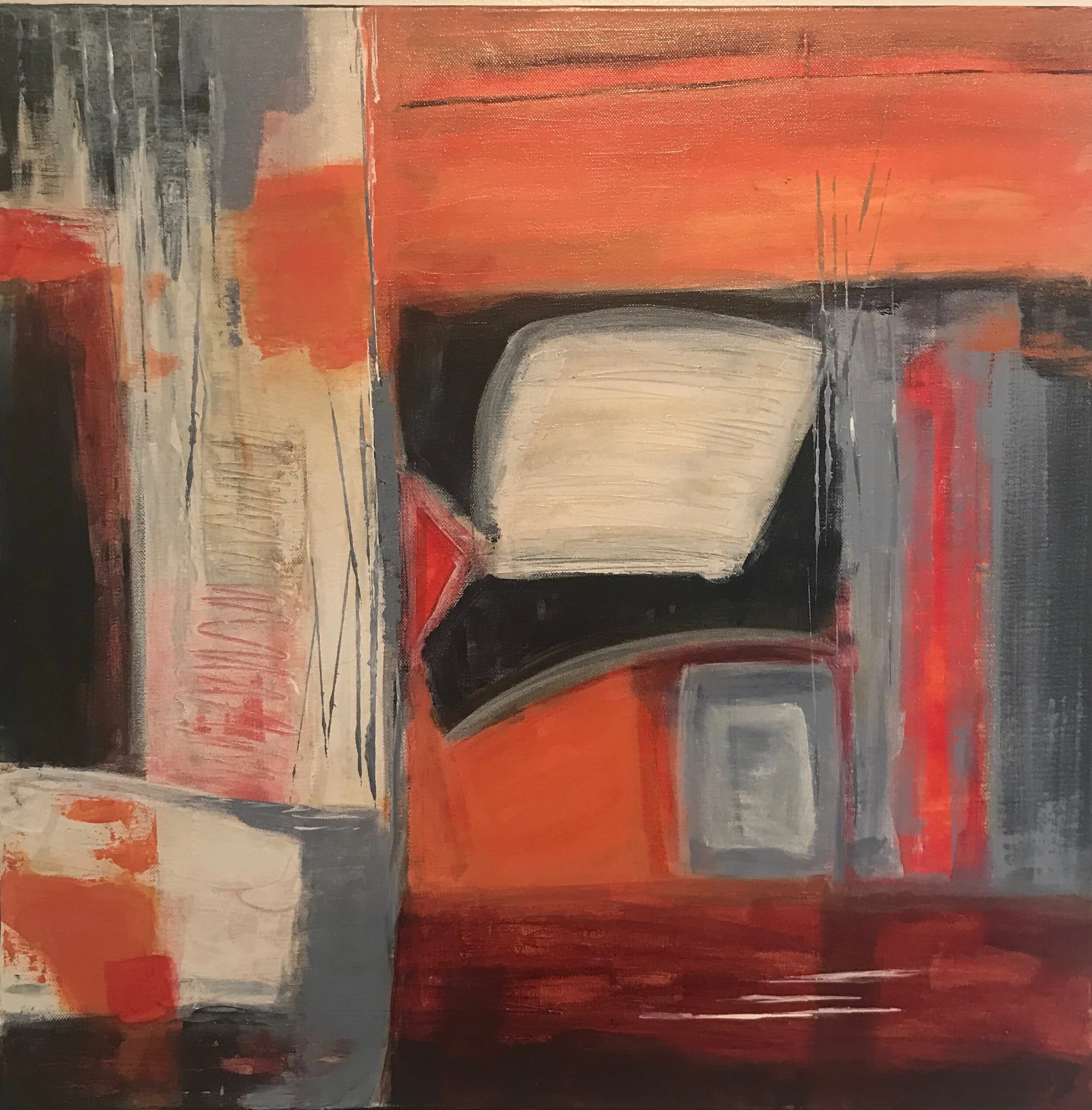
“9” by Toronto artist Daniel Mercier featured in Twist Gallery’s “Abstracting the Extract” January/February 2020 Exhibit
During the late 1930s, as WW2 was impending, many European artists that practiced surrealism had migrated to the United States. During this time, the surrealists’ drive to create art that examined an undermining reality-based human consciousness, in addition to the anxiety and trauma experienced through the world wars, had caused artists to value art as an expression of the self and chaos within the subconscious. After the war, when the United States found itself in a time of economic despair and cultural identity crisis, abstract expressionism became America’s first real contribution to the international modern art world and lead to the eventual dominance that came along with it.
Three Approaches to Abstract Expressionism
Action Painting
Action painting is characterized by random, loose, rapid and sometimes forceful handling of paint by brushstroke or techniques partially controlled by chance such as dripping or spilling paint onto the canvas. This style was most commonly used by painters Jackson Pollock, Franz Kline, and Willem de Cooning.
Abstract Impressionism
Abstract impressionism is seen as a middle ground between imitation and expressionism. This style can be described as more structured than action art but still very abstract in terms of shapes and techniques used. This style was popularized by artists Philip Guston, Helen Frankenthaler, Robert Motherwell, and Adolph Gottlieb.

“Sunlight” by Toronto artist Anna Medvedeva featured in Twist Gallery’s “Abstracting the Extract” January/February 2020 Exhibit
Colour-field Technique/Meditation
The final approach to abstract expressionism doesn’t really have a name, but for the purpose of calling it something, we will refer to it as the “colour-field technique”. This approach describes an artist that uses large fields of colour and specific abstract images to invoke a meditative experience in the viewer. Barnett Newman, Ad Reinhart and especially Mark Rothko specialized in this approach to abstract expressionism.
Meet Susan Weisz!
“My aim in painting is to explore the creative process. I constantly experiment with different techniques, the goal being to produce paintings that are thought provoking and visually appealing. Ultimately, I paint because it brings me great pleasure. If I can transfer some of that pleasure to viewers of my art, then I have succeeded beyond my wildest dreams.”

How do you describe your relationship with art? What does art mean to you?
Art can provide a variety of reactions: it can soothe, challenge, provoke, inspire, delight, or evoke no emotion whatsoever. Art allows me to see things differently and provides me with a creative outlet that can be either rewarding or frustrating, but always encourages me to push forward.

Same Story, New Perspective #1, 24x24, $575
How did you get into creating abstract artwork? What does abstract mean to you?
I began painting mostly landscapes, seascapes, and florals. Eventually I started to think of different ways to paint things beyond the traditional. I liked the results. Being able to explore different ideas without feeling constrained appeals to me. I find it interesting how the same painting can evoke strikingly different responses from different observers.
Walk us through your journey of creating an art piece.
There is no single path to creating one of my pieces. The concept for the artwork could be extrapolated from photographs, from which I isolate different sections and use each of them as a reference to create an abstract painting. A series may develop almost by accident, by observing how a specific paint reacts on certain papers. The exploration continues by deciding how these new designs can be made into esthetically pleasing pieces of artwork. Other times I may be preoccupied with a shape, such as a circle or something more random, like drips, and I would experiment, creating a series or paintings. Sometimes there is no plan to begin with- just a substrate, paint, (and perhaps other media), and the tools used for application. My paintings may be used to send a message or just to create an image born from my imagination.

Dollar & Sense #1, 24x24, $575
Whose techniques do you study, admire or aspire to follow?
I studied the techniques of the instructors whose art classes and workshops I attended. I enjoy the work of artists who cover a broad range of styles such as Steve Driscoll, Angela Leach, Lawren Harris, Tom Thompson, Jackson Pollock, and the black and white pieces of Paul-Émile Borduas, to name a few.
You can find Susan’s work right now at Twist Gallery until Friday, February 28th, 2020 and purchase her work under our “Artwork” section. Follow Susan Weisz’s work on her website and Instagram.